Created by mastermind Shigeru Miyamoto the fantasy adventure The Legend of Zelda has proven itself to be one of Nintendo’s most successful franchises. Since the release of the original title in 1986 the series has gone on to sell over 52 million copies through 14 official games as well as have various spin-offs.
Creation
The Legend of Zelda was inspired by Shigeru Miyamoto’s youth where he would explore the surrounding hillside of his hometown Kyoto for hours each day. He would explore the forests and venture into caves with the aid of a lantern, which will sound familiar to anyone who has ever played the series. Miyamoto wanted to bring to life a fantasy world that was like a “miniature garden that they [players] can put inside their drawer” and hence The Legend of Zelda was born.
While drafting the initial concept Miyamoto’s team was working on the Super Mario Bros. series simultaneously, trying to separate ideas for the two different concepts. The design team wanted Super Mario Bros. to be linear, where the action would take place in a strict order where as they wanted The Legend of Zelda to be the total opposite, giving players the freedom to explore the world while considering what to do next.
Originally the design for the debut game included a sword in the players inventory for the beginning of the adventure. The test players in Japan became confused and found fighting their way through multiple dungeons difficult according to Miyamoto. After listening to the complaints he decided to take away the beginning sword forcing players to communicate with each other and with the non-playable characters in the game to progress. Miyamoto wanted people to aid each other in solving puzzles and did not want to make the game too easy when it launched in Japan in 1986.
Gameplay
The Legend of Zelda is set in the fantasy world of Hyrule (with rare exceptions) and puts players in the boots of a Hyrulian young boy named Link. He has been chosen by destiny to gather the pieces of a mystical artifact known as the Triforce and along the way must foil the plans of the evil thief Ganon and save the Princess Zelda. The game features a mixture of puzzle solving and fighting using various items you have acquired on your travels. As you solve puzzles, explore new areas and defeat enemies you are rewarded with new items to aid you in your quest. Most Zelda games require gamers to battle their way through dungeons, solving puzzles and defeating enemies along the way before being faced with the challenge of the dungeon’s boss. At the end of each dungeon players acquire a new key item as well as a new heart container to increase the health bar. When not battling your way through terrifying dungeons players can relax in the open world and can participate in various mini-games spread throughout the villages.
The Games
The Legend of Zelda - NES (1986)
Officially debuting back in 1986,
The Legend of Zelda was first released on the Famicom-Only Disc System in Japan. A year later in 1987 a cartridge version, which introduced the battery power save, was released on the Nintendo Entertainment System (NES) in America and Europe. Set in the land of Hyrule a young boy named Link had to save the Royal Princess Zelda from the evil clutches of Ganon by collecting the eight pieces of the mystical artifact, the Triforce. Since its initial release
The Legend of Zelda has seen many ports, including to the Gameboy and most recently to the Nintendo Wii Virtual Console.
The Legend of Zelda II: The Adventure of Link – NES (1987)
The sequel to the critically acclaimed The Legend of Zelda is considered to be one of the series' rare blemishes on an almost perfect record. Ignoring the free roaming style of play that made the original so popular The Adventure of Link was a sidescroller containing some RPG elements. While being the least popular game in the series among fans it did introduce many elements into the series which have made the future games so strong. It introduced the use of magic, a common feature found in subsequent games. It introduced the Triforce of Courage which went on to play important roles in future games and gave the characters of the towns a greater role and made communicating with them much more useful.
The Legend of Zelda II takes place several seasons after the original and features the same Link although a different Zelda and made mention of Link’s defeat of Ganon. The game gives some insight to the old Hyrule showing that the Prince should have inherited the Triforce when his father died but instead he only received two sections. He received the Triforce of Power and the Triforce of Wisdom although could not get his hands on the Triforce of Courage as before the King met his death he made certain that it was hidden. The Prince questioned his sister Zelda with the help of a magician about the location of the final piece of the Triforce. When she refused to tell them its whereabouts the magician placed an eternal sleeping spell on her and forced the royal family to name their daughters Zelda in the coming generations. Link eventually receives the Triforce of Courage when he awakens the sleeping Zelda, who is not the same Zelda who he rescued in the first game. It is important to note that none of these events are ever mentioned in future games.
The Legend of Zelda: A Link to the Past – SNES (1991)
Released in 1991
The Legend of Zelda: A link to the Past went back to the top down view of the original game and did away with the side-scrolling methods that proved themselves unpopular. A Link to the Past set the foundations of the series to move into the third dimension. It brought some new features into the series such as the Master Sword and key new items such as the hookshot.
Ganondorf is revealed as the evil thief is in his demonic form as he is sealed in the ‘Golden Land’, later to become known as the ‘Sacred Realm’ with the Triforce. The 3 pieces of the Triforce were once scattered across the land and found by Ganondorf who used the power to summon his evil monsters to attack Hyrule. To save the land the Seven Sages created a seal to close the Golden Land. When Zelda alerts Link to this he must go on a quest to find the Master Sword to defeat Ganondorf and reclaim the Triforce. Unlike the first two installments this is a different Link perhaps best remembered for his classy purple hair.
The Legend of Zelda: Links Awakening – GB (1993)
For the first time the series went portable in 1993 with Link’s Awakening, it was also the first game not to feature Hyrule or Princess Zelda. Link becomes shipwrecked on Koholint Island and loses all of his equipment. He has to find 8 instruments while fighting off monsters and solving puzzles to awaken the mysterious creature watching over the Island, the Wind Fish. If it is not awaken Link will be trapped on the Island for ever.
The Legend of Zelda: Ocarina of Time – N64 (1998)
1998 saw the birth of one of the most memorable titles in gaming history, The Legend of Zelda went 3D with
Ocarina of Time. Today, a decade after its release, it still rates highly in top gaming lists as one of the greatest games ever made. Considered to be a true 3D action-adventure with role playing and puzzle elements combined with a control scheme considered to be revolutionary Ocarina of Time was always going to be legendary. The inclusion of ‘Z-Targeting’ allowed the camera to remain centered behind the enemy that the player was ‘locked-on to’ making 3D battles a dream. Throughout the game Link receives new items and larger supplies through solving puzzles and defeating enemies. Players were also able to increase their supplies through completing the various optional side quests.
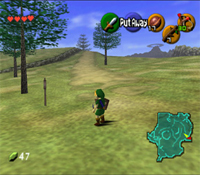
A young Boy named Link is awakened from a bad dream and brought to the Great-Duku Tree, the guardian of his village, who tells him to go to Hyrule and speak to Zelda, the Princess of his destiny. He discovers an evil king, Ganondorf, is attempting to steal the Triforce and it is Link’s destiny to stop him and return the land now in chaos to order. Link must acquire the Master Sword, a sword forged to fight evil but to do so he is frozen in the Sacred Realm for seven years until he is ready to use it, which is available to him once he obtains the sacred Ocarina of Time. Returning to Hyrule as an adult Link finds that it has turned into darkness and chaos, he must now awake the seven sages to imprison Ganondorf in the Sacred Realm, only then will Hyrule return to peace!
The Legend of Zelda: Majora’s Mask – N64 (2000)
2000 saw the release of Majora’s Mask taking place after Ocarina of Time and featuring the same Link in child form. While traveling Link is attacked by the Skull Kid and finds himself in a parallel world, Termina, which only has 3 days remaining before it is crushed by the moon. Link must continue to relive the 3 days to undo the events caused by the Skull Kid using Majora’s mask. Majora’s Mask gives Link access to a variety of different masks, allowing him to take on the form of other creatures and use their abilities. To be successful you must master the techniques of the different masks and when to use them.
The Legend of Zelda: Oracle of Seasons/Ages – GBA (2001)
Developed by Flagship games and published by Nintendo in 2001
The Legend of Zelda: Oracle of Seasons and
The Legend of Zelda: Oracle of Ages became the seventh and eighth titles in the Zelda series. Originally indented to be played as three interconnected games to be played as sequels to each other (although the order the games were played in did not matter), Flagship was forced to cancel one game due to the complexity of the system. The result was two games being release simultaneously that supported the Gameboy Link Cable using a password system. If one game is played as a sequel to the other, using the Link Cable and a password players had access to an alternate ending. Both games were built on the same game engine but play differently as
Oracle of Ages focuses on puzzles, while
Oracle of Seasons is all about the action.
The Legend of Zelda: A Link to the Past & Four Swords – GBA (2002)
Nintendo ported the 1991 smash hit
The Legend of Zelda: A link to the Past to the Gameboy Advance in 2002 as part of
The Legend of Zelda: A link to the Past & Four Swords. Besides some minor sound effect additions the game remained unchanged from the original SNES release unless the included multiplayer mode was played. The additional
Four Swords game mode was the first multilayer component in any Zelda game as it allowed up to four players to play through multiple puzzle which would unlock new techniques and areas in the main game.
The Legend of Zelda: The Wind Waker – GCN (2002)
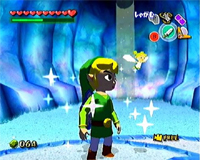
The Wind Waker caused a stir among Zelda fans when it was announced that it would be using Cell-Shaded cartoon style graphics. Many fans of the series were hoping for the game to take a more serious, dark, realistic style but instead got a more childish animated style of game. Despite initial questions over the direction the series was heading in the game was highly praised by fans and critics. The new art scheme allowed emphasis to be placed on Links emotions through the use of this larger than life eyes, which also aided in solving puzzled as Link often pointed in the right direction. The game takes place 100 years after Ocarina of Time, Hyrule has been lost for years and people now live on Islands scattered all over The Great Sea. Link must sail the seas, made up of 49 sections on a seven by seven grid in search for new abilities in order to gain the power he needs to defeat Ganondorf and return peace to Hyrule. To help you out along the way Link harnesses the power of the wind, using the mystical Wind Waker to aid you in travel and puzzles encountered throughout the quest.
The Legend of Zelda: Four Sword Adventure – GCN (2004)
Following on from the Gameboy Advance title 2 years before, Four Swords Adventures takes Zelda into the world of multiplayer. Link sets out on an adventure to restore peace to Hyrule after learning of Shadow Link, an evil counterpart of himself. Link finds that Ganon is the true villain behind all this and must set out on a quest to seal him in the Four Sword and return peace to Hyrule. One to four players are able to play simultaneously through the main quest, although if played in multiplayer Link must be controller via a Gameboy Advance using the Gamecube/GBA Link Cable so that the action can be transferred to the GBA when your character goes off screen. The Shadow Battle mode allowes between two and four players to battle it out to the death for the first time in a Zelda game.
The Legend of Zelda: The Minish Cap – GBA (2004)
Link returns cel-shaded style in an all new adventure on the GBA in
The Legend of Zelda: The Minish Cap. Using the power of a mystical hat called The Minish Cap, Link will shrink down to the size of the Minish in his quest to restore the four swords. Along the way Link must search from sacred fragments called Kingstones as only by fusing them will all the secrets be revealed. The Minish Cap was the first original Zelda game on the GBA and it showed producing some of the best graphics on the system. Along side the game came a special edition GBA SP, the console was gold in colour with the triforce symbol on the front of the unit and the Hyrule Royal Family crest on the inside of the handheld. The Minish Cap received critical acclaim and was considered to be the GBA game of 2005 by many critics.
The Legend of Zelda: Twilight Princess – Wii/GCN (2006)
Twilight Princess was the game many Zelda fans were left waiting for, it left the Cartoon Style look of the Wind Waker for a more mature, realistic feel. It was released on both the Gamecube and became a launch title for the Nintendo Wii much to the distaste of some gamers, feeling ripped off receiving a port as a major launch title. The Wii version took the tried and tested gameplay and added motion sensing controls to the mix. Players shook the Wii Remote and Nunchuck to perform attacks and used the Wii Remote to aim projectiles on the screen. While nothing revolutionary these controls helped to breathe renewed life into the series. The game focuses on Link trying to save Hyrule from being consumed by the Twilight Realm, a parallel dimension, which involves Link taking the form of a human and a wolf. Twilight Princess is most mature Zelda game to be released to date, containing more graphic violence and animated blood.
The Legend of Zelda: Phantom Hourglass – NDS (2007)
The Phantom Hourglass is the most recent Zelda game to appear having launched on the Nintendo DS handheld in 2007. It received critical acclaim for its revolutionary use of the touch screen on the handheld. The game goes back to the cel-shaded more child friendly roots of the Wind Waker and produces some of the most outstanding visuals produced on the DS to date. Phantom Hourglass is controlled entirely by using the Nintendo DS’s touch screen as the action also takes place on the bottom screen a map is place on the top screen. At first controlling Links movements as well as attacks without the use of any buttons sounds suspicious but when played it becomes apparent Nintendo know how to control their handheld. Multiplayer modes have been continued in the handheld version with battle modes being available both locally and through Nintendo’s online Wi-Fi Connection service making Phantom Hourglass the first Zelda game to support online play.
Phillips CD-i
A trilogy of Zelda games made their way onto the Phillips CD-i in the early 1990’s as collaboration between Nintendo and Phillips after they failed to create the planned CD drive add-on for the Super Nintendo. The games,
Link: The Faces of Evil, Zelda: The Wand of Gamelon, and
Zelda's Adventure are considered to be very poor by fans and critics alike and aren’t considered to be ‘real’ Zelda games, evident by the fact Nintendo has completely removed them from any official lists and only credits the official 14 Zelda games.
Awards
- Famitsu Magazine: The Legend of Zelda: Ocarina of Time - perfect 40/40
- Famitsu Magazine: The Legend of Zelda: The Wind Waker - perfect 40/40
- Famitsu Magazine: The Legend of Zelda: A Link to the Past – 39/40
- 2003 AIAS - Outstanding Achievement in Art Direction - The Legend of Zelda
- 2000 AIAS - Console Action/Adventure - The Legend of Zelda: Majora's Mask
- 2000 AIAS - Game Design - The Legend of Zelda: Majora's Mask
- 1998 AIAS - Console Game of the Year - The Legend of Zelda: Ocarina of Time
- Gamespot 2003 Game of the Year: Legend of Zelda: The Wind Waker
- Play Magazine: 2003 Game of the Year: Legend of Zelda: The Wind Waker
TV Commercials
NES Zelda Commercial, Introducing the Original Zelda Rap!
Take note this is how to sell consoles, with top quality advertising
Link to the Past Japanese Advertisement, the Zelda rap becomes the Zelda dance?
Ocarina of Time TV Commercial
Twilight Princess Trailer
Other Games Series Articles

Click on the Image to view the article
Sources:Wikipedia
zeldauniverse.com
youtube
Written By Ben Salter / ICC_06
 11/06/2008
947
8
11/06/2008
947
8
Join MyDS to vote for your favourite story!
Tags:
game
Link
Ocarina
of
Princess
Time
zelda
More Info:
MyDS Miscellaneous
Related News:
Related Reviews:
Related Videos: